


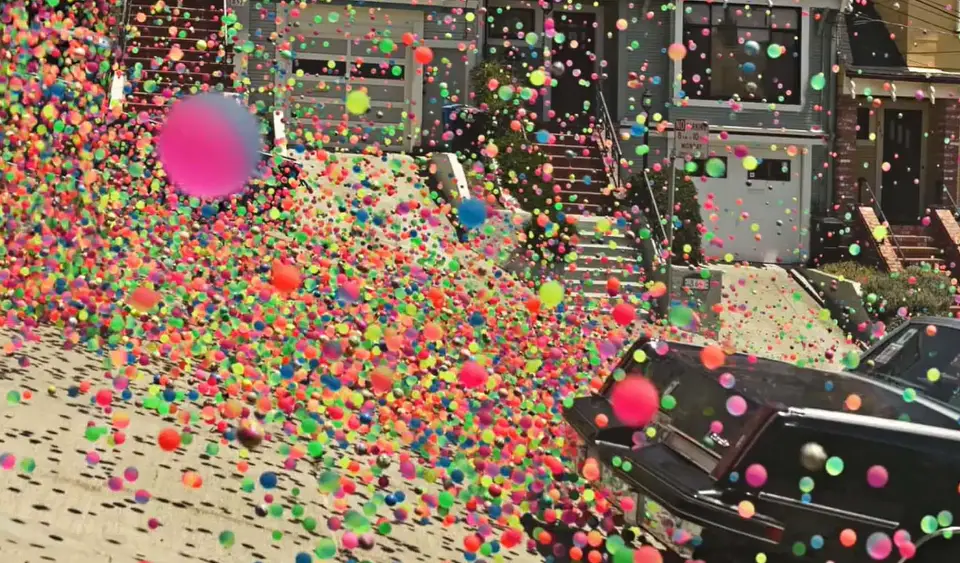
Picture this: you’re having your morning coffee in San Francisco, minding your own business, when suddenly a quarter
of a million rubber balls come screaming down your street at 136 miles per hour. That’s not a fever dream. That’s just
Tuesday in 2005, when Sony decided the best way to sell televisions was to turn one of America’s steepest cities into
an absolute warzone of colourful chaos.
The Sony Bravia “Balls” commercial started with a deceptively simple brief from ad agency Fallon: sell colour TVs with the slogan “Colour Like No Other.” Creative director Juan Cabral could’ve gone with some nice CGI, maybe a pretty sunset, perhaps a tasteful montage of vibrant imagery. Instead, he thought, “What if we just yeeted a shitload of bouncy balls down the streets of San Francisco and filmed whatever happened?”
Director Nicolai Fuglsig picked San Francisco because he’d been obsessed with the Steve McQueen film Bullitt since
childhood. Fair enough. Those hills are iconic. What nobody quite anticipated was how those same hills would turn
innocent rubber balls into high-velocity projectiles capable of absolutely ruining someone’s day.
The logistics alone were cooked. The production team had to source 250,000 bouncy balls, which meant buying literally every bouncy ball west of the Mississippi River. Location scout Patrick Ranahan recalled the absurdity of watching warehouses fill up with millions of dollars worth of children’s toys that were about to be weaponised in the name of television sales.
On shoot day, the crew loaded 25,000 balls into twelve industrial mortars. And here’s where it gets properly mental:
the crew wore Kevlar armour, riot shields, and helmets. These weren’t precautionary measures for a litigious corporate overlord. These were genuine survival necessities. Those balls reached speeds between 150 and 200 feet per second. For the non-mathematically inclined, that’s faster than some professional cricket bowlers.
Six cameras captured the mayhem, including specialised slow-motion Photo-Sonics equipment that would later make the footage look like some kind of fever dream rendered in pure colour. The balls cascaded down Filbert Street, bounced off Victorian houses, ricocheted off parked cars, and generally treated the neighbourhood like a giant pinball machine.
The city eventually told Sony to knock it off with the mortars, which is probably the most reasonable request any
government has ever made. Undeterred, the production pivoted to mounting shipping containers full of balls onto
forklifts and simply tipping them from 65 feet in the air. Because apparently “please stop firing projectiles at
buildings” doesn’t mean “please stop bombarding the streets with rubber.”
The damage bill came to $74,000 in broken windows. Not ideal, but honestly cheaper than most Hollywood productions and infinitely more entertaining than whatever explosion Michael Bay was cooking up that year.
And here’s the thing that makes this whole stunt genuinely impressive rather than just expensive: no CGI. Not a single frame was digitally enhanced. That frog you see jumping in slow motion at the 1:40 mark? Real frog. Production designer Bret Lama literally plugged a drainpipe to keep the little bastard in position until the perfect moment. That’s n t filmmaking. That’s amphibian hostage negotiation.
Set to José González’s dreamy acoustic cover of “Heartbeats,” the final cut premiered before a Premier League match on British television in November 2005. It swept advertising awards, racked up millions of YouTube views back when that actually meant something, and became one of the most remembered commercials of all time.
Twenty years later, San Francisco residents still occasionally find bouncy balls wedged in the strangest places. Some homeowners reportedly kept the ones that smashed through their windows as souvenirs. Which is either a beautiful example of making the best of a bizarre situation, or Stockholm syndrome for rubber goods.
Sony wanted to prove their TVs showed colour like no other. What they actually proved was that with enough bouncy balls, some industrial mortars, and a complete disregard for municipal property laws, you can create advertising magic. And honestly? Fair play to them.
Source: SFGate





Leave a comment